Remains of the Pinguet House and Dumont Mill
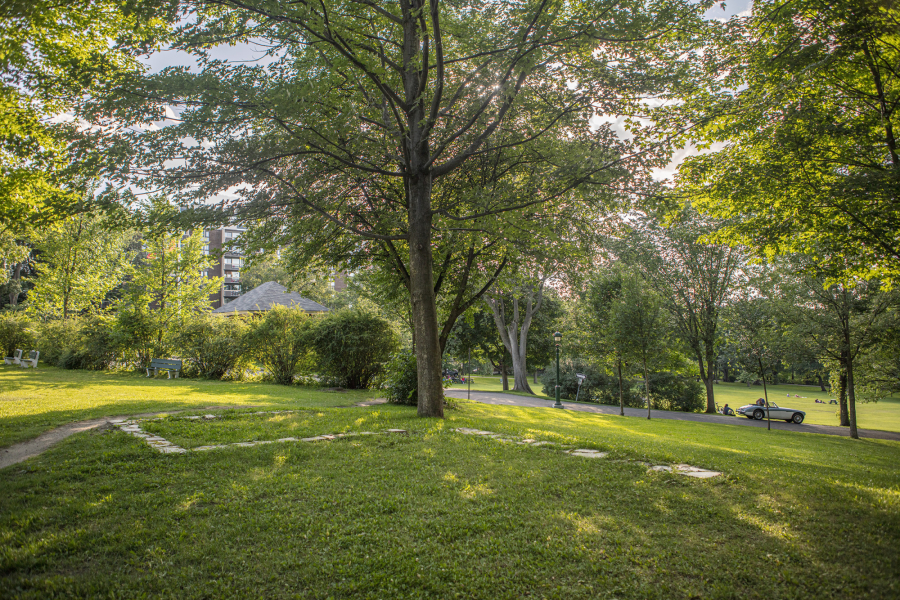
The remains of the Pinguet house and the Dumont mill are located in the present-day Braves Park. Archaeological excavations carried out on the site have located various types of foundations as well as 17th-century objects, lost or abandoned, which form an exceptional collection of remnants witnessing the living conditions of some of the earliest inhabitants in the suburbs of Quebec.
The Pinguet House
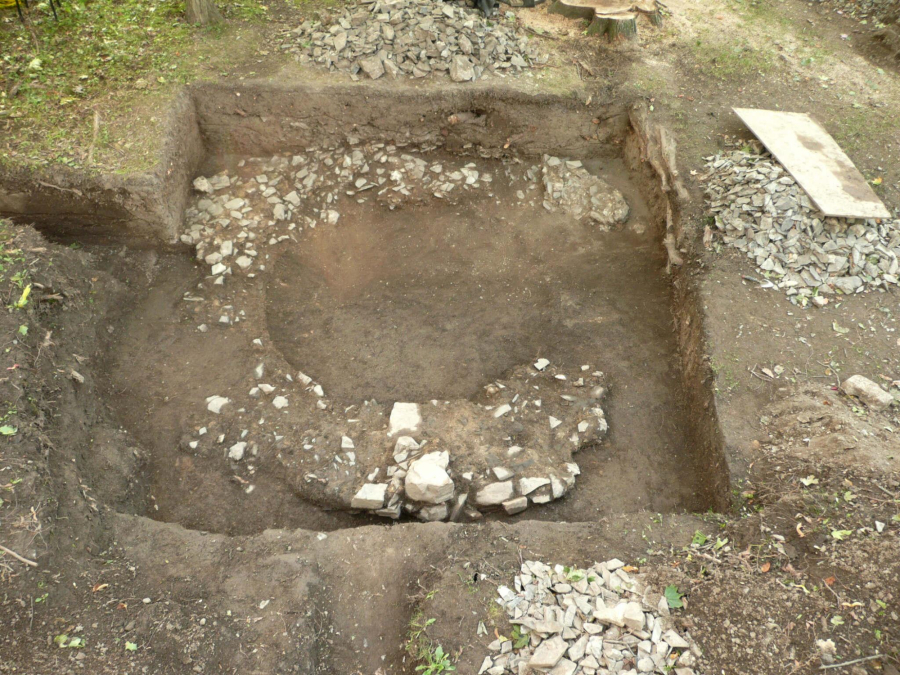
Located in the current Des Braves Park, two types of foundations were unearthed at the time on the site; of different technical invoices (dry stone and masonry), they testify to distinct phases of site occupation. The three foundation walls, south, east and west, of a small house, slightly deformed by external pressure, refer to a square building of 3.6 meters on each side, leaving an interior space of less than 10 square meters. This dwelling was just big enough for a settler to hold fire and place on his concession. It would likely be that of the trade clerk Pierre Delaporte. A foundation wall in masonry of large stone blocks, partially uncovered, reveals the construction of a new house, from the foundation walls of the first; it can be inscribed in a rectangle of 8.0 x 5.2 meters. With the construction of a second brick structure in the northeast corner of the expansion and the integration of a channel, the house arranged for the family of Henry Pinguet can be considered as a house with two hearth rooms and a bathroom. Numerous remains of wooden works, all burnt, uncovered at the location of the two building bodies testify to their destruction by a fire.
Remains of the Pinguet House and Dumont Mill
DirectionsThe Dumont Mill
The circular masonry remains, uncovered east of the terrace of Des Braves Park, allow a convincing correlation with the terms of the construction contracts for a wind tanning mill passed by Jean-Baptiste Dumont in 1747. It should not be surprising that the diameter of 4.7 meters, taken at the base of the demolition remains, exceeds that of 3.9 meters mentioned in the masonry contract; with a slight inclination of the stone tower of this mill towards the center, it was normal to establish the foundation on a slightly larger base. The only blocks left in place by the demolishers allow to establish the thickness of the wall at 0.94 meter (3 feet, French measure), leaving an interior diameter of 2.76 meters, probably sufficient for the installation of the "tanning mill". The apparent absence of remains on the west side, over a distance of 1.96 meters (6 feet, French measure), could correspond to the opening of the mill's entrance door.
The Artifacts
Archaeological excavations carried out on the site of the Pinguet house and the Dumont Mill in 1993, 2010 and 2011 allowed to unearth objects from the 17th century, lost or abandoned, which form an exceptional collection of remnants witnesses of the setting and living conditions of some of the first inhabitants in the suburbs of Quebec. Among the items of interest found, we note a token from the Chamber of Accounts of Brittany, struck in 1647, a fire striker and a tomahawk axe. The remains of domestic activities found on the site of the Pinguet house - peas, fish bones, birds and mammals as well as various types of clay containers related to food - confirm, for their part, that it is a dwelling building. Although the daily life of the settler was punctuated by subsistence activities, it is nonetheless true that a small part of coquetry was not excluded, just like spirituality. A medal, rosary beads and a small crucifix are witnesses to this.
History & Heritage
Learn more about the Dumont Mill and the Battle of Sainte-Foy.