The Challenge of the Great Wars
Following is some historical information to complete your experience and explain some liberties taken to ensure that history and our quests matched up.
Frederick George Scott - Background and Family
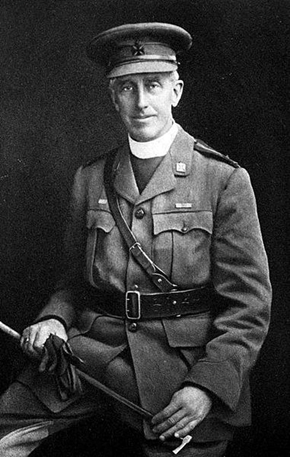
Frederick George “Canon” Scott (Montréal, 1861 – Québec, 1944) came to Québec in 1896 to become the rector of St. Matthew’s Anglican Church. He married Amy Brooks in 1887 and the couple had seven children. One child, Charles, died at age 9 around the turn of the 20th century. All the other children reached adult age. A photo of F. G. Scott (like the one at right) is found in the game book.
At the close of the 19th century, Scott wrote many poems inspired by his deep attachment to the British Empire, his patriotism, his strong Christian devotion and his love of natural, wide-open spaces and the region of Québec. He published 13 books of poetry during his career and was nicknamed the Poet of the Laurentians.
In 1914, at age 53, F. G. Scott joined the 8th Royal Rifles Regiment to participate in the Canadian war effort during the First World War (1914-1918). He enrolled as Chaplain and at war’s end held the rank of Major and Chaplain of the 1st Canadian Division.
Scott’s regiment (8th Royal Rifles) was founded in Québec in 1862. The regiment’s soldiers participated in the Boer War (1899-1902) and two world wars. The regiment was reduced to nil strength in 1966.
William B., Henry H. and Elton, Scott’s three oldest sons also served in the First World War. William was seriously wounded in one eye and returned to Canada in July 1915, where he would become a lawyer, judge and then Chief Justice of the Superior Court of Québec. Henry was mortally wounded on October 21, 1916 during the Battle of the Somme. Elton joined the Canadian artillery in 1916 and would become an Anglican preacher in the Eastern Townships, then Toronto.
It was upon his return that Scott published his memoirs of the war. His book, The Great War as I Saw It, was released in 1922 and offered a very moving account of life at the front.
In 1924, Scott participated in the inauguration of the Cross of Sacrifice. Although originally dedicated to the soldiers who sacrificed their lives during the First World War, subsequent ceremonies were held to honour the soldiers who fought in the Second World War and the Korean War.
In 1939, when the first shots of the Second World War (1939-1945) were fired, Scott returned to his regiment to offer his services. He was 78 years old. The Army declined his offer and Scott had to remain in Québec without being able to serve his regiment.
In 1941, after a challenging year in his personal life that culminated in the annihilation of his regiment during the Battle of Hong Kong, Scott decided to engrave and paint a stone on the Plains of Abraham, a place dear to his heart in Québec. The NBC has maintained this monument for a long time and it is still visible in summer near the Edwin-Bélanger Bandstand.
From August 17 to 24, 1943, Québec was the meeting place for a conference of Second World War allies. Held under the code name QUADRANT, the conference was attended by American President Franklin D. Roosevelt, British Prime Minister Winston Churchill, Canadian Prime Minister W. L. Mackenzie King and their senior military commanders. Plans for the Allied invasion of Normandy in June 1944 (Operation OVERLORD) were initiated during this conference.
Some additional anecdotes
The history of the Ross rifle began during the Boer War (South Africa, 1899-1902) when Great Britain declined to supply Canadian troops with Lee-Enfield rifles. Developed and assembled in the city of Québec, the Ross rifles were lauded for their accuracy, but proved unreliable in the trenches. Persistent problems with the rifles forced the Canadian army – which had equipped its soldiers with Ross rifles at the onset of the First World War – to revert to Lee-Enfield rifles in 1916.
The targets referred to in the escape bag rally were indeed targets to verify the accuracy of the rifles on the Plains and the behaviour of munitions.
The cannon located at the top of Cap-aux-Diamants Avenue (below) is a 24-pound Blomefield. It may have been used during the Battle of Bunker Hill (1775) and the American War of Independence. It has no direct connection with any military effort in Québec. The Blomefield was named after Sir Thomas Blomefield, a British artillery officer who greatly improved the quality of cannons at the end of the 18th century and beginning of the 19th.
The cannon near Martello Tower 1 was originlly mounted on the gun platform of Martello Tower 4. Initially, no cannons were located outside the towers – they were positioned on the top storey of each tower on gun platforms since the towers had no roofs.
The seven pieces of artillery behind the Voltigeurs de Québec Armoury were First World War trophies taken from the Germans during impressive victories at Vimy Ridge in 1917 and Amiens, Arras and Cambrai in 1918. In 1926, the War Trophy Commission appealed to the NBC to preserve and showcase the guns. They were first installed in different locations on the Plains before being grouped together at their current location in 2018.
The silhouettes of the trees are fine examples of the arboretum of the Commemorative Garden of the XII World Forestry Congress held in Québec in 2003. The 28 different species represent trees of importance to Canada’s provinces and territories, alongside species of other countries.